Not sure which tour to go on? Want to simply speak to someone? Leave your contact details here and we will get in contact with you in 24 hours regarding your request.
Oops! Something went wrong while submitting the form.
Great Wildebeest Migration: Where to See It Month by Month (2026)
Alfred Michael
23.07.2025
Updated on
15.10.2026
Every year, around 1.5 million wildebeest move in a huge loop through Tanzania's Serengeti and Kenya's Maasai Mara. Hundreds of thousands of zebras and gazelles go with them. They are all looking for fresh grass. It is one of the greatest wildlife shows on earth, and with the right timing you can see it on a safari from Moshi or Arusha. This guide shows where the herds are each month, when to see calving and river crossings, and which safari fits your dates.
What is the Great Wildebeest Migration?
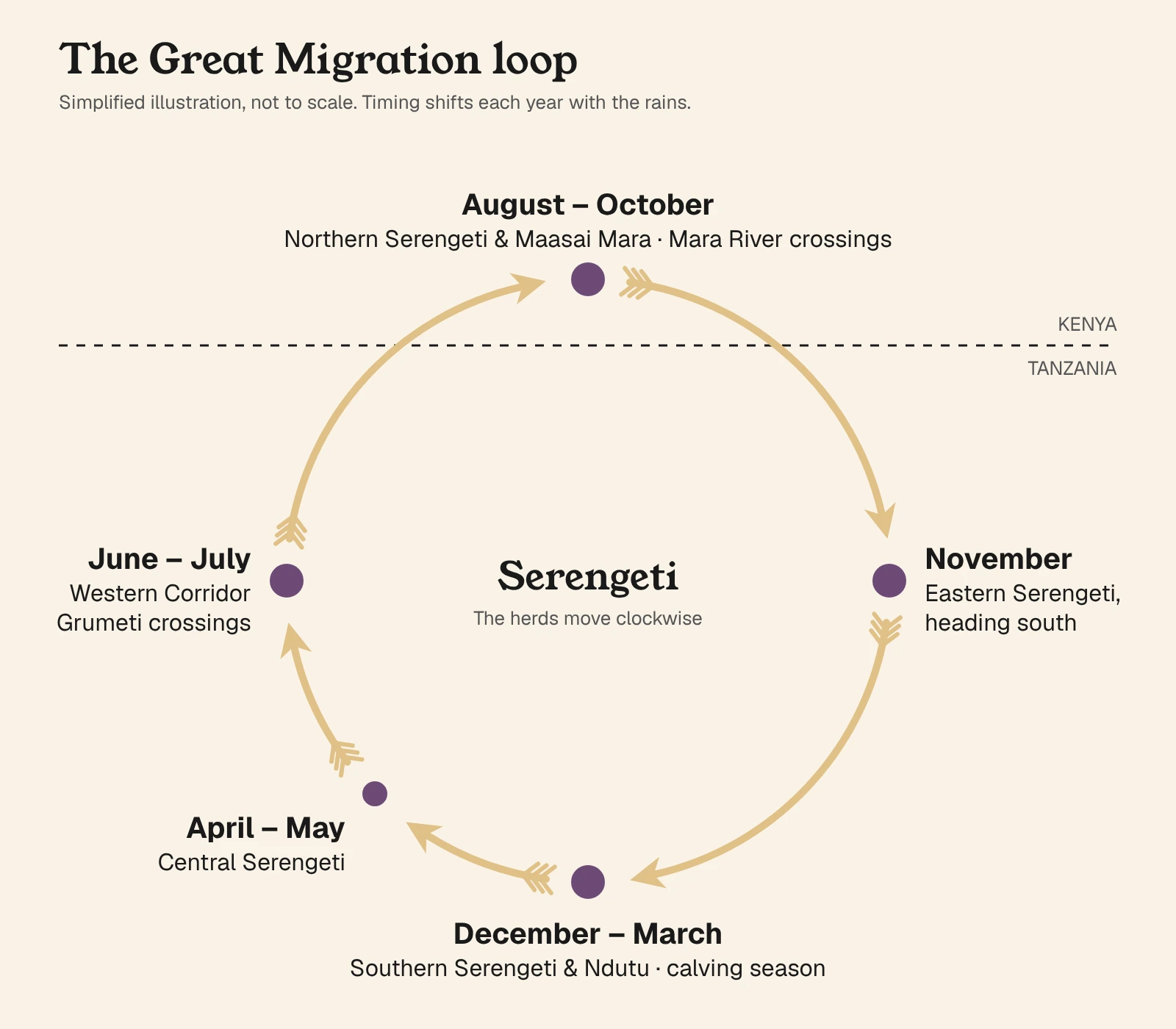
The Great Migration is the year-round movement of the wildebeest herds following the rains. When the grass runs out in one area, the herds move on to where the rain has made it grow again. The route forms a rough clockwise loop. The herds go south in the wet season, then west and north as the land dries out. When the short rains return, they head south again.
Most of the loop lies in Tanzania. The herds spend about nine months of the year in the Serengeti. They only cross into Kenya's Maasai Mara for a few months in the dry season.
Where is the migration each month?
The timing changes a little every year with the rains, so treat this as a guide rather than a timetable.
Months
Where the herds are
What's happening
December – March
Southern Serengeti and Ndutu
Calving season: hundreds of thousands of calves are born, with lots of predator action
April – May
Central Serengeti
Long rains: the herds start moving north and west; green landscapes and fewer visitors
June – July
Western Corridor (Grumeti River)
First river crossings, with crocodiles waiting in the Grumeti
August – October
Northern Serengeti and Maasai Mara
The famous Mara River crossings
November
Eastern and central Serengeti
Short rains: the herds head south again
When is the best time to see the migration?
There is no single best month, because each part of the year offers something different:
For calving season, go between late December and March. The herds gather on the short-grass plains of the southern Serengeti and Ndutu, and most calves are born around February. Lions, cheetahs and hyenas are never far away.
For river crossings, go between July and October. August and September are usually the peak months for the Mara River crossings in the northern Serengeti.
For fewer crowds, go in April or May. It is the rainy season, but the landscape is green and you will share sightings with far fewer vehicles.
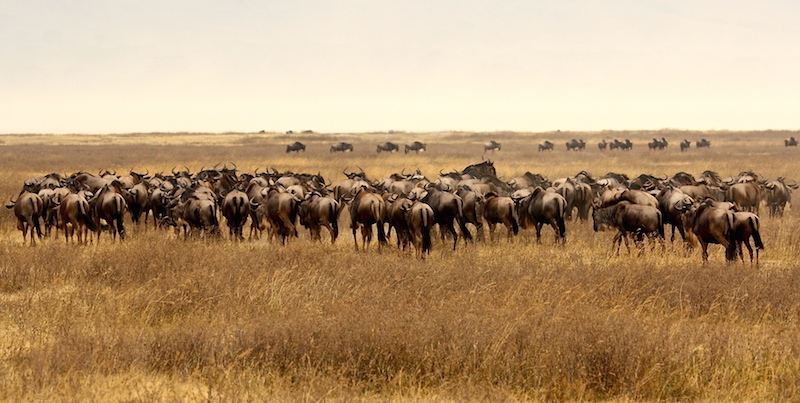
From late December, the herds settle on the open plains of the southern Serengeti and around Ndutu. The short grass here is rich in nutrients. Calves can stand and walk within minutes of birth, which they need to with so many predators around. For many guides this is the best time of year: huge herds in one place, newborn calves everywhere and dramatic hunts.
The river crossings
The crossings are the most dramatic part of the migration. Herds gather on the riverbank, sometimes for hours, before the first animals plunge in and the rest follow. Crocodiles wait in the water, and not every animal makes it across. The first crossings happen at the Grumeti River in the Western Corridor around June. The best-known ones are at the Mara River in the northern Serengeti, between July and October.
Crossings are never guaranteed on a given day. The more days you spend in the area, the better your chances.
More than wildebeest
The herds draw in the predators. Lions, cheetahs, leopards, hyenas and jackals follow the migration, and crocodiles wait at the rivers. On the way you will also see giraffes, elephants, buffaloes and many kinds of antelope.
Our migration safaris also visit the Ngorongoro Crater, one of the few places where you have a chance to see all of the Big Five in a single day. Read more about Africa's Big Five and what to expect at the Ngorongoro Crater.
Tanzania or Kenya?
The Maasai Mara is famous for the river crossings, but the herds only stay there for a few months. The Serengeti hosts the migration for most of the year, including the whole calving season. It is also far larger, so sightings are usually less crowded. If you are travelling outside August to October, Tanzania is the better choice.
How many days do you need?
Plan at least two to three full days in the Serengeti. That gives you time to find the herds and enjoy them without rushing. Most visitors add the Ngorongoro Crater, so a safari of 4 to 7 days works well.
Day 1: Tarangire National Park. Drive from Arusha or Moshi to Tarangire, famous for its baobab trees and big elephant herds. Overnight in Karatu.
Day 2: Ngorongoro Crater. Descend about 600 metres onto the crater floor, one of the best places in East Africa to spot the endangered black rhino. Overnight near the crater highlands.
Days 3–4: Ndutu and the southern Serengeti. Two full days with the herds. At the peak of calving, around 8,000 calves are born every day. Off-road driving is allowed in parts of Ndutu, so your guide can get you closer to the action.
Day 5: Back to Arusha or Moshi. A last morning game drive on the way back.
Our Great Migration safaris
Our migration safaris follow where the herds are expected to be:
The Great Migration Calving Season Safari (5 days, from $2,400). Timed for calving season, from mid-December to March. Game drives in the southern Serengeti and Ndutu.
Great Migration Western Corridor Lodging Safari (7 days, from $4,050). A private lodge safari. You fly from Arusha straight into the Western Serengeti, then travel on to the Central Serengeti, the Ngorongoro Crater and Tarangire.
The Supreme Safari (4 days, from $910). Our popular camping safari to the Serengeti and the Ngorongoro Crater.
Not sure which month suits you? Browse all our Tanzania safaris or ask us and we will match a safari to your dates.
Photography and packing tips
Bring a zoom lens. A lens of around 100–400 mm lets you photograph animals without disturbing them.
Pack spare batteries and memory cards. You will take far more photos than you expect, and charging points are limited on camping safaris.
Protect your gear from dust. A simple cover or bag keeps dust out, especially in the dry season.
Bring binoculars. They help you spot animals far out on the plains.
Dress in layers and neutral colours. Early mornings can be cold, and the days get hot. Pack a light rain jacket for the green season.
In February the herds are usually in the southern Serengeti and around Ndutu. It is the peak of the calving season.
When are the river crossings?
The first crossings happen at the Grumeti River around June. The Mara River crossings in the northern Serengeti usually take place between July and October, with August and September as the peak months.
Can I see the migration all year round?
Yes. The herds are always somewhere in the Serengeti–Mara ecosystem. What changes is where they are and what they are doing, so the key is to choose the right area for your travel dates.
Is the migration guaranteed?
No. The migration follows the rains, and the timing shifts from year to year. Spending more days in the right area gives you the best chance of finding the herds.
Plan your migration safari
Seeing the Great Migration is a once-in-a-lifetime trip, and timing is everything. Tell us when you want to travel and we will help you choose the best safari. Contact us or email us at info@vivaafricatours.com.
Unsure what is the right package for you? Need more information? We are here to help, so give us a call or send us a message. Our staff are happy to help you with any questions and to find the best activities based on your needs.